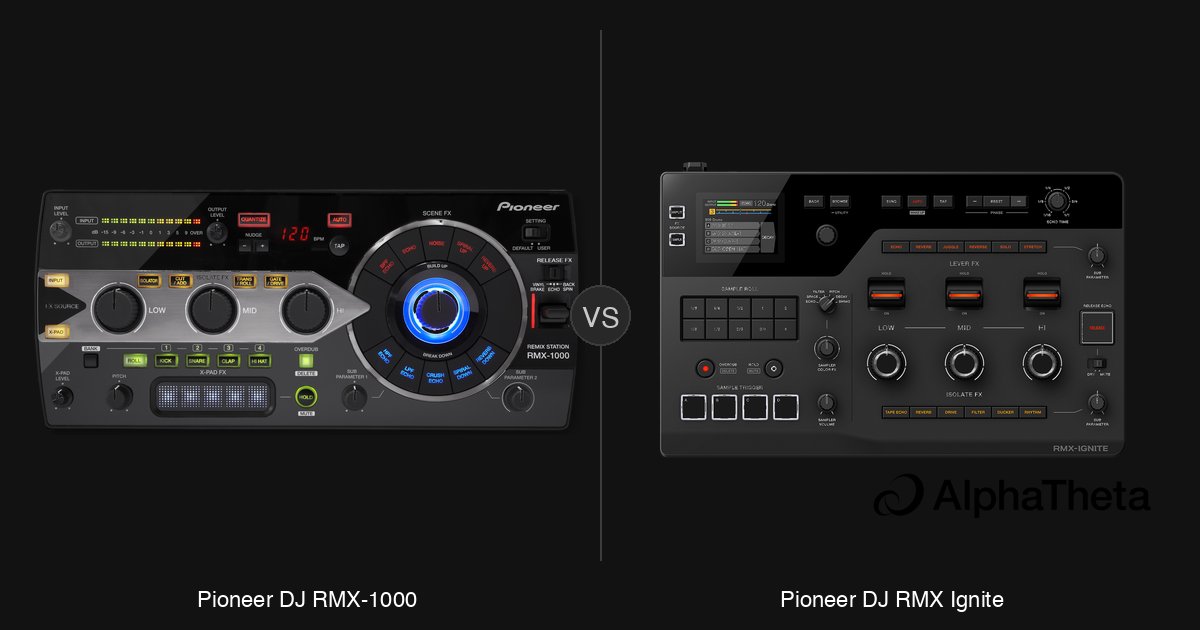

For over a decade, the Pioneer DJ RMX-1000 was a fixture on festival stages and in club booths worldwide. As a DJ who’s been playing Afro House and Tech House for over 15 years, I’ve played on both the RMX-1000 and the new RMX Ignite — and know both units from first-hand experience. Then, in late 2025, the RMX-1000 was quietly discontinued. And in early 2026, AlphaTheta unveiled its successor: the RMX Ignite. An entirely new device, twice the price, with a fundamentally different control philosophy. The community is divided. This article is my attempt to compare both units objectively — with verified specs, real-world experience, and community voices.
The RMX-1000: How an Effects Processor Became a Legend
The Pioneer DJ RMX-1000 launched in 2012 and was an outlier from the start: a standalone effects processor that wasn’t built into a mixer but inserted separately into the signal chain. Pioneer called it the “Remix Station” — a name that perfectly captured its concept. It wasn’t meant to replace mixer effects but to add an entirely new creative layer.
What made the unit special from day one was its physical interface: a large Scene FX knob dominated the surface, offering instant, intuitive access to ten different effect types. Add the Isolator FX, Release FX, and the X-Pad — a 24-field drum trigger with sampler functionality — and you had a remarkably compact, performance-oriented tool for its time.
RMX-1000 Technical Specifications
Under the hood, the RMX-1000 ran at 48 kHz with 24-bit depth — the standard of the early 2010s. Key specifications at a glance:
- A/D-D/A conversion: 48 kHz / 24-bit
- Signal-to-noise ratio: 102 dB
- THD+N: < 0.005% (20 Hz – 20 kHz)
- Headroom: 20 dB
- Frequency response: 20 Hz – 20 kHz (±0.5 dB)
- Connections: 1/4″ jack (TS) + RCA + USB-B
- Dimensions: 334 × 157 × 57 mm
- Weight: 1.3 kg
- Launch price: approx. €749 / $699
102 dB S/N ratio and under 0.005% THD were solid numbers for 2012, though they look modest next to today’s 32-bit converters. The 20 dB headroom ensured the unit didn’t clip during energetic sets.
The Effects: Why DJs Love the RMX-1000
The real strength of the RMX-1000 was never in the specs — it was in how it felt. The effect sections were clearly separated and immediately accessible:
Scene FX (10 types): BPF Echo, Echo, Echo+, Crush, HPF, LPF, Noise, Reverb Down, Reverb Up, Spiral Down, Spiral Up. The large centre knob controlled intensity and wet/dry — one hand movement was enough for dramatic transitions.
Isolator FX (6 types): Cut/Add, Trans/Roll, Gate/Drive. Each type was split across three frequency bands (Low, Mid, High), enabling targeted, musical interventions.
Release FX (3 types): Back Spin, Echo, Vinyl Brake. These effects triggered on release of the Scene FX knob — a brilliant design detail that no other hardware had solved this elegantly.
X-Pad: 24 fields (4×6) for drum triggers and 16 fields (4×4) for samples. Combined with the mixer’s beat sync, DJs could instantly layer claps, snare rolls, and percussion over a running mix.
It was precisely this X-Pad that made the RMX-1000 indispensable in certain genres. In Tech House and Afro House, the snare roll buildups via the X-Pad became the sonic signature of an entire generation of DJs. The community coined a fitting nickname: “The Clap Machine.”

The Cult Status: “On 60% of Big DJ Riders”
What set the RMX-1000 apart from other effects processors was its gradual adoption at the professional level. It was never a mainstream device per se — most club DJs performed without one. But at the touring level, it became something close to standard equipment.
A Reddit user who works professionally in event production put it bluntly: “It’s on about 60% of riders of the big DJs, along with 4 × CDJ3000 and a V10LF. I call it the clap machine.” This aligns with what I’ve personally observed in German clubs and at festivals.
Which Artists Use the RMX-1000?
The list of DJs who actively deploy the RMX-1000 in their sets (or at least have it on their rider) reads like a who’s who of electronic music:
- Amelie Lens — regular fixture in her techno sets
- Charlotte de Witte — permanent part of the setup
- Enrico Sangiuliano — creative live effects work
- Mau P — Tech House with signature buildups
- Marten Lou — Afro House / Tech House, RMX-1000 as a permanent fixture on the technical rider
- Franky Rizardo — House / Tech House
- Maceo Plex — often combined with multiple effects units
- Carl Cox — needs no introduction
- Hot Since 82 — “loves that thing,” per the community
- James Zabiela — widely considered a “wizard” with the RMX-1000
- Blond:ish — Organic House / Melodic Techno
- Sasha — uses three RMX-1000 units, one per CDJ
- Røyksøpp — live performance integration
- Cassian — heavy use at Tomorrowland sets
Sasha’s setup is particularly noteworthy: three RMX-1000 units — one per CDJ — for maximum control over individual channels. That speaks to how seriously some artists take this device. James Zabiela, meanwhile, is regarded as a performance artist who uses the RMX-1000 so creatively that the community has dubbed him a “wizard.”
Then again, there’s the other side: “Twice now I’ve had to track one down because it’s on a DJ’s rider only for him never to touch it once” — an observation that’s more common among event technicians than you’d think. Not everyone who has the RMX-1000 on their rider actually uses it.
The Revival: Why the RMX-1000 Surged in Popularity
To properly contextualise the RMX-1000, you need to understand the moment in which it experienced its second wind. Starting around 2020/2021, the sound of electronic music shifted noticeably towards Afro House, Melodic Techno, and the “Ibiza sound” — genres built on percussive elements, long buildups, and atmospheric transitions.
This is exactly where the RMX-1000 excelled: the snare roll function via the X-Pad became the signature sound of entire festival stages. Clap buildups, layered over multiple bars and released into the drop, are now so ubiquitous that some DJs critique them: “A lot of people use the snare roll to do buildups which is cheesy af,” as one Redditor noted. Love it or hate it — the RMX-1000 popularised that sound.
A second factor mattered too: DJs who play on Allen & Heath Xone mixers (like the Xone:96 or Xone:92) have no on-board effects. The RMX-1000 offered the perfect complement — as an insert effect in the signal chain or via send/return. Particularly in the Afro and Deep House scene, where Xone mixers are favoured for their analogue warmth, the RMX-1000 became an indispensable companion.
Some DJs even used it primarily as a master isolator — regardless of the effects. One user described their setup: “I mostly use it as a master isolator to go along with the A9.” The versatility of the device extended well beyond its original concept.
Discontinued and Overpriced: The Used Market Explodes
In mid-2025, the RMX-1000 was officially discontinued — alongside the CDJ-3000, as confirmed by distributors. The news didn’t come as a complete shock, but the consequence was clear: used prices surged.
Current listings on Reverb.com illustrate the range:
- “Very Good” condition: from approx. €449 (Spain)
- “Good” to “Very Good”: €900 – €980 (Italy, UK)
- Like New / Boxed: up to €1,059 (USA)
For reference: the original retail price was around €749 in 2012. A device that’s over a decade old is now fetching more than its original launch price on the used market. One Redditor who sold theirs confirmed: “Sold it for more than I paid for it.” Another documented: “I paid $800 last year from B&H and now it’s $839 — elsewhere over $1,000.”
A community member summed up the discontinuation perfectly: “Seems like an odd time to discontinue it as there’s probably more interest in these devices now than there was when they launched.” Hard to argue with that.
The Successor: AlphaTheta RMX Ignite
In January 2026, AlphaTheta unveiled the successor: the RMX Ignite. Not “RMX-2000,” not “RMX-1000 MK2” — an entirely new product with a new name, a new design language, and a significantly higher price point of €1,199 / $1,199 / £1,039. That’s roughly a 60% increase over the predecessor.
The Ignite breaks with its predecessor in almost every way. Where the RMX-1000 relied on a large, intuitive knob, the Ignite features a colour display, a lever as its central control element, and a completely reworked effects architecture. The philosophy has shifted: from immediately graspable hardware tool to screen-assisted effects station.
RMX Ignite Technical Specifications
- A/D-D/A conversion: 96 kHz / 32-bit (ESS Technology converters)
- Signal-to-noise ratio: 115 dB
- Connections: USB-C (power + digital audio) + 1/4″ jack (TS, unbalanced) + LAN (Pro DJ Link)
- Display: Multicolour display
- Dimensions: 340 × 213.3 × 72.8 mm
- Weight: 2.3 kg
- Price: €1,199 / $1,199 / £1,039
The generational leap in specifications is clear: from 48 kHz / 24-bit to 96 kHz / 32-bit, from 102 dB to 115 dB S/N ratio. ESS Technology converters are considered reference-grade in the audio industry and are also used in the DJM-A9. Reviewers describe the Ignite’s sound as “neutral — neither warm nor bright, just clean and transparent.”
Particularly noteworthy is the USB-C integration: paired with a DJM-A9 or DJM-V10, a single USB-C cable handles both power and digital audio. No separate power supply, no jack-to-jack cable — one cable does everything. That’s a genuine improvement for live setups.
Effects Comparison: Old Concept, New Philosophy
This is where the most significant change lies — and simultaneously the biggest point of contention. The RMX Ignite has fundamentally restructured its effects sections:
Scene FX → Isolate FX
The large Scene FX knob of the RMX-1000 — the centrepiece of the unit — is gone from the Ignite. In its place are the Isolate FX: six effect types (Tape Echo, Reverb, Drive, Filter, Ducker, Rhythm) that can be assigned per frequency band (Low, Mid, High). Control is via three separate knobs rather than one large one.
Conceptually, this is a paradigm shift: instead of a one-knob “all-or-nothing” effect, the Ignite offers granular, frequency-selective effect control. Musically speaking, it’s a powerful tool — but the simplicity and immediacy of the old knob is lost.
New: Lever FX
The most striking new control element is the Lever — a spring-loaded mechanism that controls six effect types: Echo, Reverb, Juggle, Reverse, Solo, and Stretch. The lever automatically returns to centre on release, triggering the release effect. Conceptually it’s similar to the RMX-1000’s Release FX, but with significantly more control through the lever’s physical travel.
The Juggle effect slices loops from running audio, Reverse plays it backwards, Stretch slows it down — all BPM-synced via Pro DJ Link. For performative DJs who like to play with live audio, the lever is a genuine asset.
Sampler: Upgraded with Caveats
The Ignite’s sampler offers four rubber pads (17.5 mm) instead of the RMX-1000’s expansive X-Pad. In return, there are 20 samples across five banks (909, 808, 707, 606, plus a “Loop and Play” bank). New features like Groove Roll (rhythmic sample repeats), Overdub, and Sampler Color FX (Echo, Space, Filter, Pitch, Decay, Swing) considerably expand the creative possibilities.
However, something crucial is missing: surface area. The RMX-1000’s X-Pad with its 24 trigger fields was physically large enough for intuitive, quick pattern playing. Four 17.5 mm pads require a different, less spontaneous approach. Whether the additional software features compensate is a matter of taste.
Custom samples can be loaded via USB or Pro DJ Link — a long-requested feature that was only awkwardly possible on the RMX-1000 through the remixbox software.
Pro DJ Link: The Quiet Revolution
Pro DJ Link integration via the LAN port is arguably the most important upgrade on paper. The Ignite automatically syncs with CDJ-3000s, the DJM-A9/V10, and other Pro DJ Link-enabled devices. BPM tempo, beat grid, and phase information are shared in real time.
In practice, this means: no more manual tap tempo, no more slightly out-of-sync effects. The Groove Roll follows the grid of the running tracks exactly. This was one of the most frequently voiced wishes from the community: “Pro DJ Link” appeared on virtually every wish list for an RMX successor.
Spec Comparison: RMX-1000 vs. RMX Ignite at a Glance
The following table summarises the key technical differences:
| Feature | RMX-1000 (2012) | RMX Ignite (2026) |
|---|---|---|
| Sample Rate / Bit Depth | 48 kHz / 24-bit | 96 kHz / 32-bit |
| Signal-to-Noise Ratio | 102 dB | 115 dB |
| D/A Converters | Not specified | ESS Technology |
| Primary Effects Control | Large Scene FX Knob | Lever + 3 Isolate FX Knobs |
| Effect Types (Scene / Lever) | 10 Scene FX | 6 Lever FX + 6 Isolate FX |
| Isolator | 6 types (3-band) | Integrated into Isolate FX (per band) |
| Release FX | 3 types (Back Spin, Echo, Vinyl Brake) | Release Echo (Dry + Mute modes) |
| Sampler | X-Pad (24 + 16 fields) | 4 pads, 20 samples, 5 banks + Groove Roll |
| Display | None | Multicolour display |
| Pro DJ Link | No | Yes (LAN) |
| USB Audio | USB-B (controller mode) | USB-C (audio + power) |
| Outputs | 1/4″ TS + RCA (unbalanced) | 1/4″ TS (unbalanced) |
| Dimensions | 334 × 157 × 57 mm | 340 × 213 × 73 mm |
| Weight | 1.3 kg | 2.3 kg |
| Price | €749 (2012) | €1,199 (2026) |
Audio Quality: A Direct Comparison
Numbers alone never tell the full story — but the generational leap in audio specifications between the RMX-1000 and the RMX Ignite is substantial. The following charts visualise the key differences based on official manufacturer data:
On paper, the Ignite is superior in every measurable category. But numbers don’t tell the whole story — especially not for a device whose appeal was always rooted in physical immediacy.
Community Reactions: Excitement Meets Criticism
The RMX Ignite announcement triggered a split reaction in the DJ community. The Reddit release thread reached 51 upvotes and over 100 comments — substantial engagement for a niche product. The criticism clusters around five main themes:
1. Price Shock
The reaction to the €1,199 price tag was nearly universally negative. A jump from €749 to €1,199 — roughly 60% more — for a device many DJs consider “nice to have” rather than essential was a surprise. For context: the DJM-A9, a full 4-channel mixer, launched at around €2,499. An effects processor at nearly half the price of a flagship mixer takes some justifying.
2. The Missing Big Knob
The removal of the large Scene FX knob was the most emotional criticism. For many DJs, that knob was the essence of the RMX-1000: one grab, one effect, instant control. The lever as replacement offers physical feedback too, but a different kind — linear rather than rotational. And the Isolate FX with their three separate knobs demand more cognitive bandwidth than a single intuitive twist.
3. Unbalanced Outputs
The RMX Ignite exclusively offers 1/4″ TS outputs — unbalanced. For a professional device in the €1,200 price range, this is disappointing. Balanced outputs (TRS or XLR) protect the signal from interference and hum, especially over longer cable runs in club installations. That AlphaTheta cut corners here is hard to understand.
4. Ecosystem Lock-in
The USB-C integration only works with AlphaTheta mixers (DJM-A9, DJM-V10). Anyone running the Ignite with a Xone:96, a rotary mixer, or an older DJM must fall back to the analogue jack connection — losing the single-cable simplicity. A wet/dry knob for send/return operation on non-AlphaTheta mixers is also absent. The Ignite is noticeably optimised for the AlphaTheta ecosystem.
5. Polarising Design
The orange “Ignite” accents on the black metal chassis divided opinion. Some found it fresh and modern; others felt it was visually intrusive — particularly in the context of a typical club booth aesthetic dominated by black and silver hardware. A matter of taste, but it shows AlphaTheta deliberately broke with the predecessor’s conservative design.
What the Community Had Wished For
Before the Ignite was announced, community members had assembled their wish lists for an RMX successor across multiple Reddit threads. A comparison reveals what was fulfilled — and what wasn’t:
- ✅ Pro DJ Link: Fulfilled — LAN port for beat sync
- ✅ 96 kHz / 32-bit: Fulfilled — with ESS converters
- ✅ USB sample loading: Fulfilled — via USB and Pro DJ Link
- ✅ Better reverb/delay algorithms: (Likely) fulfilled — new engine, but no direct A/B comparison available
- ❌ Stems isolation: Missing — no integrated source separation
- ❌ Balanced outputs: Missing — still unbalanced only
- ❌ Wet/dry for external mixers: Missing — no independent wet/dry control
- ❌ Compressor with sidechain: Missing
- ❌ Send/return loop: Missing — no patching of external effects
- ❌ More pads / larger pad surface: Fewer pads than before (4 instead of 24+16)
The picture is mixed: the technical upgrades (audio quality, connectivity) are there. But the features that would have made the RMX a versatile, mixer-agnostic tool are absent. The Ignite is a better device within the AlphaTheta ecosystem — but a more limited device outside of it.
Practical Assessment: Who Should Buy What?
After extensive research and personal assessment, I see three typical scenarios:
Scenario 1: You Play on DJM-A9 / V10 and Want Maximum Integration
→ RMX Ignite. The USB-C integration, Pro DJ Link, and 96 kHz / 32-bit audio quality make a genuine difference within the AlphaTheta ecosystem. One cable, a clean digital signal chain, automatic beat sync. If you have the budget and value the improved audio quality, the Ignite is the logical evolution.
Scenario 2: You Play on Xone, Rotary, or an Older Mixer
→ RMX-1000 (used) — if you can find one. Without USB-C integration, the Ignite loses its biggest advantage. The unbalanced outputs remain a problem. The RMX-1000 offers better value here — provided you can find a well-maintained unit at a reasonable price. At current used prices of €449 – €1,059, that’s no longer guaranteed.
Scenario 3: You Want Clap Buildups and Snare Rolls — Nothing Else
→ Neither as a new purchase. If the X-Pad was the only reason you wanted the RMX-1000, sampler functions in Rekordbox, Serato, or Traktor are now mature enough to cover that. €1,199 for a clap trigger — you don’t need to do that. The RMX Ignite offers substantially more, but only if you’re willing to embrace the new effects concepts.
Verdict: Evolution, Not Revolution — and That’s Okay
The RMX Ignite isn’t a direct successor to the RMX-1000 — it’s a conceptually different device that occupies the same slot in the signal chain. AlphaTheta chose not to simply repackage the old formula with better specs, but to fundamentally rethink the control philosophy. That’s bold. Whether it’s wise will be decided by the community over the next year or two.
What’s certain: the RMX-1000 earned its cult status. It helped shape the sound of an entire era, was deployed by the world’s biggest DJs, and — despite its technical limitations — created an emotional bond that no spec sheet can reproduce. The missing big knob on the Ignite isn’t just an ergonomic detail — it’s a symbol of the shift from intuitive hardware to software-assisted complexity.
For me personally — as someone who’s been playing Afro House and Tech House for years and has played on both devices — the difference is tangible. The RMX-1000 was raw, direct, and incomparably intuitive. The Ignite offers more technically but demands a learning curve that the predecessor never required. Will the Ignite take the RMX-1000’s place in DJ booths? First, it needs to appear on the riders of the big DJs. And there, it has to prove itself — not on the datasheet, but in practice, under pressure, at 3 AM.
Interested in the tech behind the scenes? On my blog, I regularly write about technology topics — from comparing DJ mixers to AI automation for businesses. Got questions? Get in touch.